


S32205 vs S31254 Stainless Steel: Key Differences, Performance, and Application Guide
When selecting corrosion-resistant materials for demanding environments, understanding the differences between duplex and super austenitic alloys is essential. This S32205 vs S31254 stainless steel comparison provides a practical guide for engineers and procurement professionals working in marine, chemical, and energy industries.
Both materials offer excellent corrosion resistance, but their composition, mechanical properties, and application focus differ significantly. Choosing the right alloy can directly impact equipment lifespan, maintenance costs, and project safety.
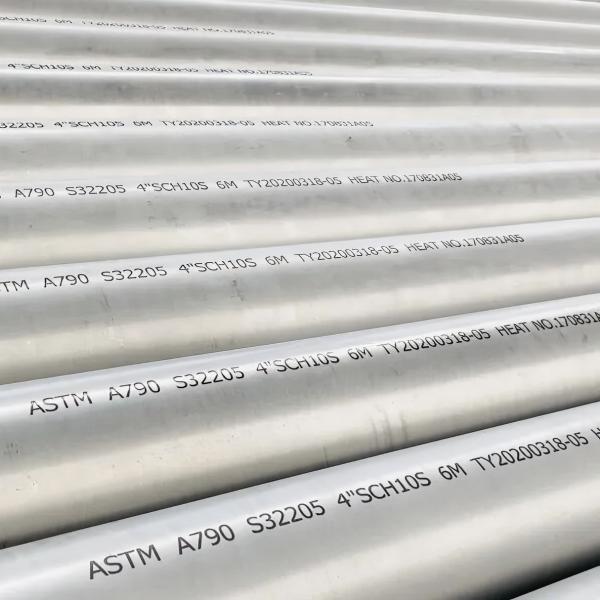
ASTM A790 S32205 stainless steel pipes
Chemical Composition: Duplex Balance vs High Alloy Design
S32205 Duplex Stainless Steel
S32205 duplex stainless steel features a balanced duplex microstructure of austenite and ferrite, delivering a combination of strength and corrosion resistance.
- Chromium (Cr): 22–23%
- Nickel (Ni): 4.5–6.5%
- Molybdenum (Mo): 3.0–3.5%
- Nitrogen (N): 0.14–0.20%
This composition enhances resistance to pitting corrosion while maintaining high mechanical strength.
S31254 Super Austenitic Stainless Steel
S31254 stainless steel-also known as 254SMO-is a high-alloy austenitic stainless steel designed for extreme chloride environments.
- Chromium (Cr): 19.5-20.5%
- Nickel (Ni): 17.5-18.5%
- Molybdenum (Mo): 6.0-6.5%
- Nitrogen (N): 0.18-0.25%
The significantly higher molybdenum and nickel content gives it superior resistance to chloride-induced corrosion.
Core Difference
In this S32205 vs S31254 stainless steel comparison, the key distinction lies in alloying strategy:
- S32205 relies on duplex structure for balanced performance
- S31254 relies on heavy alloying for extreme corrosion resistance
Mechanical Properties: Strength vs Ductility
S32205
- Yield strength: ≥450 MPa
- Tensile strength: ≥620 MPa
- Elongation: ≥25%
Its duplex structure provides excellent strength, making it ideal for high-pressure and high-load applications.
S31254
- Yield strength: ≥300 MPa
- Tensile strength: ≥650 MPa
- Elongation: ≥40%
It offers superior ductility and toughness, especially useful for complex fabrication.
Key Takeaway
In this S32205 vs S31254 stainless steel comparison, S32205 is preferred for strength-critical applications, while S31254 is better for forming-intensive or highly corrosive environments.
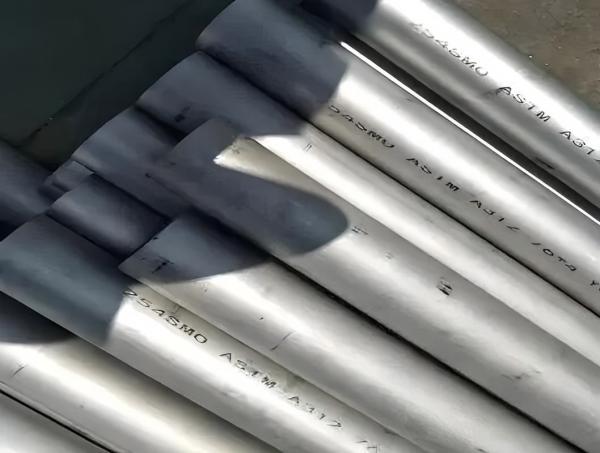
S31254 254SMO stainless steel pipes for corrosive chemical environments
Heat Treatment and Welding Considerations
S32205
- Solution annealing: 1020–1100°C with rapid cooling
- Requires careful control of interpass temperature during welding to maintain phase balance
S31254
- Solution annealing: 1150–1200°C
- Requires high-alloy welding consumables (e.g., ERNiCrMo-3)
- Sensitive to sigma phase formation if improperly processed
Key Difference
S31254 requires stricter process control and higher heat treatment temperatures due to its high alloy content.
Application Scenarios: Moderate vs Extreme Corrosion Environments
S32205 Typical Applications
- Offshore platforms and subsea pipelines
- Seawater systems (chloride ≤5000 ppm)
- Flue gas desulfurization (FGD) units
- Pressure vessels and structural components
S31254 Typical Applications
- Seawater desalination evaporators
- High-chloride chemical processing systems
- Acidic and high-temperature environments
- Advanced marine and offshore equipment
Application Insight
This S32205 vs S31254 stainless steel comparison clearly shows:
- S32205 is suitable for moderate chloride environments and high strength needs
- S31254 is ideal for extreme corrosion conditions with high chloride concentration (up to 50,000 ppm)
Standards and Specifications
S32205
- ASTM A240/A240M
- EN 1.4462
- GB/T 20878 (S22053)
S31254
- ASTM A240/A480
- EN 1.4547 (254SMO)
- GB/T 20878 (S31252)
Ganyeah Group Project Experience
At Ganyeah Group, we have supplied both duplex and super austenitic stainless steel materials to global engineering projects.
Offshore Seawater Pipeline Project (Southeast Asia)
For a marine engineering client, we provided S32205 duplex stainless steel pipes for seawater transport systems. The project required high strength and resistance to chloride corrosion under moderate temperature conditions. The use of S32205 reduced material costs while ensuring long-term durability.
Desalination Plant Project (Middle East)
In a desalination project, we supplied S31254 stainless steel pipes and fittings for evaporator systems exposed to extremely high chloride concentrations. The superior corrosion resistance of S31254 ensured stable long-term operation with minimal maintenance.
How to Choose Between S32205 and S31254
- Choose S32205 when you need high strength and good corrosion resistance in moderate chloride environments
- Choose S31254 when facing extreme corrosion, high chloride levels, or elevated temperatures
Selecting the correct alloy is critical to achieving both technical reliability and cost efficiency.
FAQ: S32205 vs S31254 Stainless Steel
1. Which is better for seawater applications?
Both are suitable, but S32205 is widely used for general seawater systems, while S31254 is preferred for higher chloride concentrations or more aggressive conditions.
2. Is S31254 more corrosion-resistant than S32205?
Yes. Due to its higher molybdenum and nickel content, S31254 offers superior resistance to pitting and crevice corrosion.
3. Why is S32205 stronger than S31254?
The duplex microstructure (austenite + ferrite) gives S32205 higher yield strength compared to fully austenitic S31254.
4. Which material is more cost-effective?
S32205 is generally more cost-effective, while S31254 is more expensive due to higher alloy content but performs better in extreme environments.
5. Can Ganyeah Group help select the right material?
Yes. Ganyeah Group provides technical support to help customers choose the most suitable stainless steel grade based on operating conditions.
Contact Ganyeah Group
Ganyeah Group specializes in supplying high-performance stainless steel pipes, duplex alloys, and super austenitic materials for global industries.
📩 Contact us today to get expert advice and a competitive quotation tailored to your project.
Suggested Image ALT Text
-
S32205 vs S31254 stainless steel pipe comparison for industrial applications
-
duplex and super austenitic stainless steel pipes in marine engineering
-
S31254 stainless steel pipes used in desalination plant systems