


Can S31254 (254SMO) Stainless Steel Be Used in Hydrochloric Acid? Corrosion Resistance Explained
Selecting the right material for highly corrosive chemical environments is critical for the safety and lifespan of industrial equipment. Among advanced corrosion-resistant alloys, S31254 stainless steel-commonly known as 254SMO—is widely recognized for its excellent resistance to chloride-containing environments such as seawater and chemical processing systems.
However, when it comes to hydrochloric acid environments, especially at high concentrations, engineers must carefully evaluate whether S31254 stainless steel is the right material choice.
This article explains the corrosion performance of S31254 stainless steel in hydrochloric acid, its limitations, and alternative materials recommended for severe acid service.
What Is S31254 (254SMO) Stainless Steel?
S31254, also known as 254SMO, is a super austenitic stainless steel alloy developed for aggressive chloride environments. The alloy contains high levels of molybdenum and nitrogen, which significantly improve resistance to pitting, crevice corrosion, and stress corrosion cracking.
Typical composition includes:
- Chromium (Cr): ~20%
- Nickel (Ni): ~18%
- Molybdenum (Mo): 6–7%
- Nitrogen (N): enhanced content for corrosion resistance
These elements provide a high pitting resistance equivalent number (PREN), making the alloy particularly suitable for seawater systems, desalination equipment, and offshore applications.
Because of this excellent chloride resistance, S31254 stainless steel pipes and fittings are commonly used in marine engineering, chemical processing, and flue gas desulfurization systems.
1. Performance of S31254 Stainless Steel in Diluted Hydrochloric Acid
In low-concentration hydrochloric acid solutions, S31254 stainless steel corrosion resistance in diluted hydrochloric acid can be acceptable under controlled conditions.
Compared with conventional stainless steels such as 316L, which generally cannot tolerate hydrochloric acid environments, S31254 performs significantly better. At room temperature and low acid concentration, the alloy can maintain reasonable corrosion resistance if proper design precautions are taken.
Key considerations include:
- Avoiding crevices and stagnant zones
- Maintaining clean surfaces to prevent localized corrosion
- Controlling temperature and impurity levels
Under these conditions, S31254 stainless steel can sometimes be used in diluted hydrochloric acid systems for limited applications.
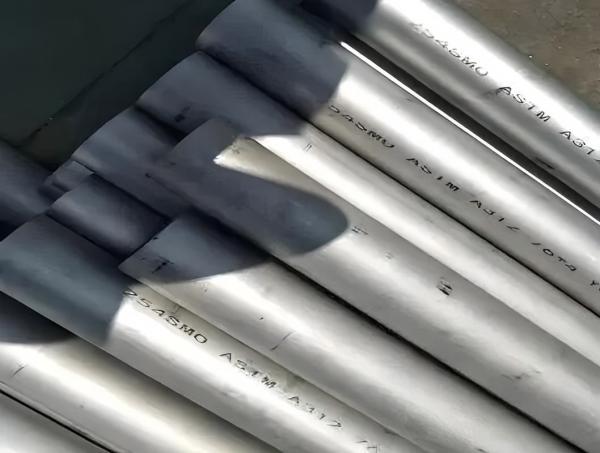
S31254 254SMO stainless steel pipes for corrosive chemical environments
2. Limitations of S31254 in High-Concentration Hydrochloric Acid
Despite its advanced alloy composition, S31254 stainless steel is not recommended for high-concentration hydrochloric acid environments.
The main reason is that concentrated hydrochloric acid is a strong reducing acid, which differs significantly from the oxidizing or chloride environments that S31254 is designed to resist.
Instability of the Passive Film
Stainless steels rely on a stable passive oxide film for corrosion resistance. In strong reducing acids like concentrated hydrochloric acid, this protective film can break down easily.
Without a stable passive layer, uniform corrosion or localized attack may occur, even in high-alloy stainless steels.
High Chloride Concentration Risks
Hydrochloric acid also contains extremely high concentrations of chloride ions (Cl⁻), which can accelerate:
- Pitting corrosion
- Crevice corrosion
- General corrosion in non-oxidizing acids
As a result, S31254 stainless steel corrosion resistance in concentrated hydrochloric acid is limited, especially in long-term service conditions.
3. Effects of Temperature and Complex Chemical Environments
Industrial environments rarely involve pure acids alone. Factors such as temperature, oxidizing impurities, and metal ions can significantly affect corrosion behavior.
Studies show that in acidic environments containing Cl⁻, corrosion rates increase rapidly when additional ions such as Fe³⁺ or NO₃⁻ are present.
For example, in simulated flue-gas condensation systems, the combined effects of:
- High temperature
- Chloride ions
- Oxidizing contaminants
can accelerate both uniform corrosion and pitting corrosion of S31254 stainless steel.
Therefore, when high-concentration hydrochloric acid is combined with elevated temperature or impurities, the corrosion risk increases substantially.
4. Recommended Materials for Concentrated Hydrochloric Acid
For long-term storage or transport of concentrated hydrochloric acid, engineers usually select materials specifically designed for strong reducing acids.
Common alternatives include:
Nickel-based alloys
- Hastelloy C‑276
- Hastelloy B‑2
These alloys offer excellent resistance to strong reducing acids and are widely used in hydrochloric acid handling equipment.
Titanium and titanium alloys
- Good corrosion resistance in certain hydrochloric acid concentrations
- Often used in chemical processing equipment
Non-metallic materials
- Fiberglass reinforced plastic (FRP)
- Polytetrafluoroethylene (PTFE)
These materials are often chosen because they provide complete resistance to hydrochloric acid corrosion.
Choosing the Right Corrosion-Resistant Material
Although S31254 (254SMO) stainless steel is one of the most corrosion-resistant stainless steels available, its application must follow the environments it was designed for—particularly chloride-containing oxidizing environments such as seawater and chemical processing systems.
For high-concentration hydrochloric acid service, selecting specialized corrosion-resistant alloys or non-metallic materials is usually the safer solution.
At Ganyeah Group, we provide a wide range of high-performance stainless steel pipes, super austenitic alloys, and corrosion-resistant materials for demanding industrial environments.
If your project involves aggressive chemical media or acid handling systems, our technical team can help you select the most suitable material for long-term reliability and safety.
📩 Contact Ganyeah Group today to discuss your corrosion-resistant alloy requirements.