


Thin Wall Stainless Steel Pipe: How to Choose the Right Wall Thickness for Your Project
A thinner stainless steel pipe does not automatically mean a better piping system. In building water supply and other applications where weight, installation efficiency and material cost matter, reducing wall thickness can be an effective way to optimize the system—but only when the selected pipe can still meet the pressure, temperature, corrosion and connection requirements of the project.
This is where thin wall stainless steel pipe becomes particularly interesting. Austenitic stainless steel combines corrosion resistance, mechanical strength and good fabrication performance, allowing engineers to reduce unnecessary material without sacrificing the reliability expected from a permanent piping system.
For water supply applications, some standards and specifications define thin-wall stainless steel pipe using the relationship between wall thickness and outside diameter. In one commonly referenced water-piping definition, a stainless steel pipe with a wall-thickness-to-outside-diameter ratio of no more than 6% is classified as thin wall. However, the exact dimensional requirements should always be checked against the standard governing the project.
What Is Thin Wall Stainless Steel Pipe?
Thin-wall stainless steel piping is not simply conventional stainless steel pipe made thinner. It is a design approach in which the wall thickness is selected according to the actual service requirements of the system.
Austenitic grades such as 304 and 316/316L are commonly considered for applications where corrosion resistance, cleanliness and fabrication performance are important. ASTM A269, for example, covers seamless and welded austenitic stainless steel tubing for general service, while other product standards apply depending on the application and dimensions.
The key point is that wall thickness should be treated as a design parameter, not an isolated purchasing specification.
For a project engineer, the better question is not:
“What is the thinnest pipe available?”
It is:
“What is the minimum practical wall thickness that provides sufficient performance throughout the expected service life?”
That distinction can make a significant difference to the final piping system.
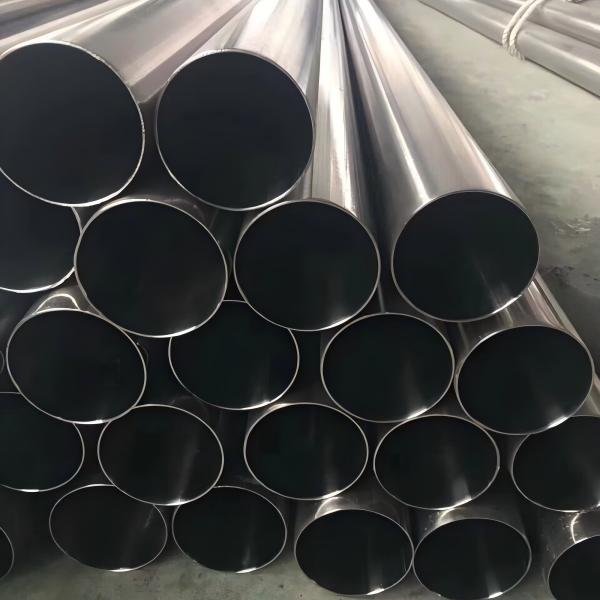
Thin wall stainless steel pipe for building water supply
Why Are Thin-Wall Stainless Steel Pipes Becoming More Attractive?
The growing interest in thin-wall stainless steel piping is closely related to the need for lighter, cleaner and more efficient building services.
Stainless steel already offers an important advantage over many conventional piping materials: its chromium-containing surface forms a passive oxide layer that provides strong resistance to atmospheric and many aqueous corrosion environments. Stainless steel piping is also widely used in potable-water applications because it can provide long-term corrosion resistance without introducing corrosion products from the pipe material into the water.
Reducing unnecessary wall thickness can further improve the overall system by lowering pipe weight and reducing the amount of stainless steel required.
This can be particularly useful for:
- Building water supply systems
- Hot and cold water distribution
- Commercial and residential buildings
- Hospitals and public facilities
- Food and beverage plants
- Pharmaceutical facilities
- Light industrial piping
- Utility and process water systems
- Applications where installation weight is a concern
However, thin-wall design should always remain within the limits established by the applicable engineering standard and project specification.
5 Practical Advantages of Thin Wall Stainless Steel Pipe
1. Corrosion Resistance and Clean Internal Surfaces
The primary reason engineers choose stainless steel is usually not its appearance or weight—it is its resistance to corrosion.
A properly selected stainless steel grade can provide a clean internal surface with less tendency toward corrosion products and deposits than many conventional metallic piping materials. This is particularly valuable in water distribution, sanitary and process applications where fluid cleanliness matters.
For more demanding chloride-containing environments, 316L may be considered instead of 304, depending on the actual chemistry and temperature.
2. Good Strength-to-Weight Performance
Reducing wall thickness lowers the mass of the pipe, but the material itself still retains the mechanical characteristics of stainless steel.
This creates a useful balance between structural performance and weight. In high-rise buildings or projects with long piping runs, reducing pipe weight can simplify handling and installation.
That said, pressure capacity cannot be inferred from material grade alone. Diameter, wall thickness, temperature, allowable stress, joint efficiency and design code all affect the final calculation.
3. Easier Transportation and Installation
A lighter pipe is easier to move, position and support.
This can be especially useful on projects where pipes need to be transported through narrow access routes, lifted to upper floors or installed in congested mechanical spaces.
When combined with an appropriate mechanical connection system, thin-wall stainless steel piping can also reduce the amount of hot work required on site.
Press-fitting systems, for example, have helped expand the use of thin-walled stainless steel in potable-water plumbing because they provide a practical alternative to conventional welded joints.
4. Efficient Use of Stainless Steel
Stainless steel has a higher material cost than many carbon steel alternatives. Therefore, simply increasing wall thickness without considering the actual design requirement can increase the total project cost.
A correctly engineered thin-wall system can use stainless steel more efficiently.
The goal is not to reduce thickness at any cost. The goal is to eliminate unnecessary thickness while maintaining adequate safety margins and service performance.
5. Long-Term Piping Performance
Service life depends on far more than wall thickness.
Material grade, water chemistry, temperature, pressure, connection quality, installation practices and external environmental conditions all influence long-term performance.
For stainless steel piping systems, correct material selection and installation can be more important than simply choosing the thickest available pipe. Engineering guidance also emphasizes evaluating compatibility between the stainless steel grade and the fluid being transported.
How to Select the Wall Thickness of Thin Wall Stainless Steel Pipe
This is the most important part of the selection process.
1. Start With the Material Grade
304 is widely used for general water and architectural applications because of its balance of corrosion resistance, mechanical properties and cost.
316L becomes more attractive when the environment contains higher chloride exposure or when improved corrosion resistance is required.
For specialized industrial services, other austenitic, duplex or nickel-alloy materials may be more appropriate.
For example:
| Project Condition | Potential Material Direction | Key Consideration |
| General building water | 304 / 304L | Balance of cost and corrosion resistance |
| Higher chloride exposure | 316 / 316L | Improved resistance compared with 304 |
| Sanitary processing | 304L / 316L | Surface condition and cleanliness |
| More aggressive process media | 316L or higher alloy | Verify actual chemistry and temperature |
| High-pressure industrial service | Project-specific grade | Wall calculation and applicable code |
Material selection should always be based on the actual medium rather than on grade popularity alone.
2. Consider the Connection Method
Connection technology is one of the most overlooked factors when selecting a thin-wall pipe.
Traditional welding and flanged connections can impose different requirements on wall thickness, joint preparation and fabrication. Modern mechanical joining systems can make thinner pipe practical in applications where the connection system has been specifically designed for it.
The important question is therefore not simply:
“How thick is the pipe?”
It is:
“Is the pipe wall compatible with the selected connection system?”
This becomes particularly important when a project uses press fittings, grooved connections, compression systems or other mechanical joints.
3. Check Operating Pressure and Temperature
Wall thickness must be evaluated against the actual operating conditions.
Before selecting a thin wall stainless steel pipe, engineers should identify:
- Design pressure
- Normal operating pressure
- Design temperature
- Minimum operating temperature
- Fluid density
- Corrosive characteristics
- External loads
- Support spacing
- Thermal expansion
- Required service life
For example, a thin wall pipe suitable for a low-pressure building water system should not automatically be transferred to a high-pressure industrial process line.
Classification rules for stainless steel piping similarly determine minimum thickness using design calculations and material properties rather than treating wall thickness as a one-size-fits-all value.
4. Evaluate Installation Conditions
Installation can change the practical requirements of a pipe.
A pipe installed inside a protected building service shaft has different external risks from one exposed to construction impact, vibration, buried conditions or marine environments.
For concealed or buried applications, external corrosion protection and installation details may also need to be considered. The pipe should not be selected based solely on its nominal wall thickness.
5. Balance Material Cost Against Lifecycle Cost
A thicker pipe increases the initial material cost.
A thinner pipe may reduce material consumption, transportation weight and installation effort.
But selecting a wall that is too thin can create other costs if it results in difficult fabrication, connection limitations or inadequate resistance to the actual service environment.
The best specification is therefore the one that achieves the required performance at the lowest reasonable lifecycle cost-not necessarily the lowest purchase price.
Thin Wall Stainless Steel Pipe vs. Conventional Stainless Steel Pipe
The difference is not simply “thin versus thick.” It is mainly about how the pipe is engineered for the intended application.
| Factor | Thin-Wall Design | Conventional / Heavier-Wall Design |
| Material consumption | Lower | Higher |
| Pipe weight | Lower | Higher |
| Handling | Generally easier | More demanding |
| Installation | Can be faster with suitable joints | Often requires more fabrication |
| Pressure capability | Depends strongly on design | Generally greater thickness margin |
| Material cost | Potentially lower | Higher |
| Connection requirements | More sensitive | More flexible in some applications |
| Application range | Best when properly engineered | Broader for demanding services |
This comparison does not mean that thin-wall construction is always superior. In high-pressure, high-temperature or mechanically demanding applications, additional wall thickness may be necessary.
Where Can Thin Wall Stainless Steel Pipe Be Used?
The strongest applications are those where corrosion resistance and clean service are important, while the required pressure and mechanical loads remain compatible with a reduced wall design.
Typical applications include:
Building Water Supply
Thin-wall stainless steel piping can be used for hot and cold water distribution in residential buildings, hotels, hospitals, commercial buildings and public facilities.
The combination of corrosion resistance, clean internal surfaces and lower weight makes stainless steel attractive for long building-service runs.
Potable Water Systems
Stainless steel has a long history in potable-water applications, particularly where maintaining water quality and minimizing corrosion products are important.
Food and Pharmaceutical Facilities
Where cleanliness and corrosion resistance are priorities, stainless steel provides an established material platform. The final tube or pipe grade, surface finish, joining method and cleaning requirements should be specified according to the process.
Industrial Utility Systems
Low- and moderate-pressure utility services can sometimes benefit from thinner stainless steel piping where the operating conditions and applicable codes permit it.
Lightweight Building Services
For large buildings, reducing the weight of long pipe runs can simplify handling and reduce the load imposed on supports and building structures.
Ganyeah Group: Turning Material Selection Into a Project-Specific Solution
For an international stainless steel supplier, supplying the pipe itself is only one part of the job. The more important question is whether the material specification makes sense for the customer’s actual project.
At Ganyeah Group, stainless steel pipe selection can be approached from several connected parameters: grade, dimensions, wall thickness, applicable standard, surface requirements and intended service.
For example, when a customer is considering 304 or 316L thin-wall stainless steel pipe, the recommendation should not be based simply on the lowest material price. The project team needs to understand the medium, operating conditions, connection method and installation environment first.
This project-oriented approach is especially useful for overseas buyers who may provide only a basic inquiry such as:
“304 stainless steel pipe, thin wall, for water supply.”
Before confirming the specification, Ganyeah Group can work from the application requirements and help narrow down the appropriate material and dimensional range.
For larger engineering projects, this approach also helps coordinate stainless steel pipes with associated pipeline components, reducing the risk of selecting a pipe specification that is incompatible with the rest of the system.
A Practical Project Selection Example
Consider a commercial building requiring stainless steel water distribution.
The project does not necessarily benefit from using the heaviest stainless steel pipe available. A more rational process would be:
Water quality → operating pressure → temperature → pipe diameter → required wall thickness → connection method → installation environment → applicable standard
If 304 provides sufficient corrosion resistance, there may be no technical reason to upgrade every line to 316L.
Likewise, if the selected connection system is designed for thin-wall tubing, using unnecessarily thick pipe may increase material and installation costs without creating a corresponding benefit.
This is the type of engineering balance that can turn a standard stainless steel pipe purchase into a more cost-effective piping solution.
What Should Buyers Confirm Before Ordering?
Before sending an inquiry for thin-wall stainless steel piping, buyers should ideally provide:
Material grade — such as 304, 304L, 316 or 316L
Outside diameter or nominal size
Required wall thickness
Pipe length
Seamless or welded construction
Applicable standard
Operating pressure
Operating temperature
Fluid or service medium
Connection method
Surface finish requirements
Inspection and documentation requirements
Providing these details at the inquiry stage allows the supplier to evaluate the specification more accurately instead of simply quoting a generic pipe price.
Frequently Asked Questions
1. What is thin wall stainless steel pipe?
It is stainless steel piping manufactured or specified with a relatively small wall thickness compared with its outside diameter. In certain water-piping specifications, a wall-thickness-to-outside-diameter ratio of 6% or less is used to define thin-wall stainless steel pipe.
2. Is thin-wall stainless steel pipe suitable for water supply?
Yes, when the selected grade, wall thickness, connection system and pressure rating are suitable for the project. Stainless steel is widely used in potable-water and building water systems because of its corrosion resistance and clean internal surface.
3. Is 304 or 316L better for thin-wall stainless steel pipe?
Neither is universally better. 304 is often suitable for general water and building applications, while 316L may be preferred where chloride exposure or corrosion severity is higher. The actual water or process chemistry should determine the choice.
4. Does a thinner pipe always cost less?
Not necessarily. A thinner wall can reduce stainless steel consumption, but total project cost also depends on forming, welding, connection technology, installation and inspection requirements.
5. Can thin-wall stainless steel pipe be welded?
Yes, depending on the product design and applicable specification. However, thinner walls require tighter control of welding parameters, heat input, penetration and distortion. The selected welding procedure should be appropriate for the actual pipe dimensions and grade.
6. How do I choose the right wall thickness?
Start with design pressure, temperature, fluid characteristics, pipe diameter, material grade, connection method and applicable design code. Wall thickness should then be calculated or selected according to the governing specification rather than chosen only by price.
7. Can Ganyeah Group supply customized stainless steel pipe specifications?
Ganyeah Group can work with project-specific requirements for stainless steel piping, including material grade, dimensions, standards and application conditions. Buyers should provide as much project information as possible so the specification can be reviewed accurately.