


2205 vs 2507 Duplex Stainless Steel Pipe: How to Choose the Right Grade?
When 304 or 316L stainless steel can no longer provide enough corrosion resistance, engineers often turn to duplex stainless steel. Its two-phase microstructure combines the corrosion resistance of austenitic stainless steel with the high strength of ferritic stainless steel, making it particularly useful for demanding oil & gas, chemical processing, marine and desalination applications.
For many projects, however, the real question is not simply whether duplex stainless steel is suitable, but whether 2205 or 2507 duplex stainless steel pipe is the better choice.
At Ganyeah Group, material selection is always considered together with operating temperature, chloride concentration, pressure, corrosion conditions, fabrication requirements and project standards. This approach helps customers avoid both under-specification and unnecessary material costs.
What Is Duplex Stainless Steel?
Duplex stainless steel contains both austenitic and ferritic phases, typically designed to achieve a balanced microstructure after solution annealing. This structure gives duplex grades a combination of properties that is difficult to obtain from conventional 300-series stainless steels.
Compared with 316L, duplex stainless steel generally offers:
- Higher yield strength
- Better resistance to chloride stress corrosion cracking
- Strong resistance to pitting and crevice corrosion
- Good mechanical toughness and ductility
- Potential for thinner wall designs because of its higher strength
- Lower nickel content than many highly alloyed austenitic grades
For pipeline applications, these characteristics can translate into reduced material weight and longer service life, particularly where chloride-containing fluids are involved.
2205 vs 2507 Duplex Stainless Steel Pipe
The two grades are often discussed together, but they are intended for different levels of corrosion severity.
| Property | 2205 Duplex Stainless Steel | 2507 Super Duplex Stainless Steel |
| UNS designation | S31803 / S32205 | S32750 |
| Type | Duplex | Super duplex |
| Typical PREN | About 34–38 | Typically above 42 |
| Yield strength | ≥450 MPa* | ≥550 MPa* |
| Chloride corrosion resistance | Excellent | Extremely high |
| Stress corrosion cracking resistance | Excellent | Excellent |
| Common standards | ASTM A789 / A790 | ASTM A789 / A790 |
| Typical application level | Moderate to high corrosion | Severe corrosion |
| Relative cost | Medium-high | High |
*Actual mechanical requirements depend on the applicable material specification, product form and grade.
The key difference is alloying level. 2507 contains higher levels of chromium, molybdenum and nitrogen than 2205, giving it stronger resistance to localized corrosion in aggressive chloride environments.
However, higher corrosion resistance does not automatically make 2507 the better choice for every project. If 2205 already meets the design requirements, upgrading to 2507 can unnecessarily increase procurement costs and fabrication considerations.

2205 duplex stainless steel pipes produced by Ganyeah Group
1. When Is 2205 Duplex Stainless Steel Pipe a Good Choice?
2205 duplex stainless steel pipe is one of the most widely used duplex grades because it provides a practical balance between corrosion resistance, mechanical strength and cost.
It is particularly suitable when the process fluid contains chloride but the operating conditions are not at the extreme end of the corrosion spectrum.
Typical applications include:
Chemical processing
2205 can be used in selected chemical piping systems where chloride-containing process fluids create a higher corrosion risk than conventional 304L or 316L can comfortably handle.
Oil and gas pipelines
Its high strength and resistance to chloride stress corrosion cracking make 2205 attractive for selected oil and gas applications, especially where both mechanical loading and corrosion resistance need to be considered.
Desalination
2205 can be used in appropriate sections of desalination plants, particularly where the environment is corrosive but does not require the higher alloy content of a super duplex grade.
Pulp and paper
Chloride-containing process environments can make material selection challenging. 2205 provides an alternative to conventional stainless steel where higher corrosion resistance is required.
High-corrosion process equipment
Where 316L approaches its practical corrosion-resistance limits, 2205 may provide a more economical upgrade without immediately moving to a super duplex or nickel alloy.
2. When Should You Choose 2507 Super Duplex?
2507 super duplex stainless steel pipe is designed for more aggressive service conditions.
Its higher alloy content provides improved resistance to pitting, crevice corrosion and chloride-containing environments. This makes it particularly valuable when the consequences of localized corrosion are serious.
Typical applications include:
- Seawater piping
- Offshore platforms
- Desalination systems
- High-chloride process piping
- Flue gas desulfurization equipment
- Offshore oil and gas facilities
- Aggressive chemical processing systems
For example, seawater service combines high chloride concentration with oxygen and temperature variations. In such conditions, a material with a higher pitting resistance is often preferable to conventional 316L or standard duplex grades.
This is where 2507 super duplex stainless steel pipe can provide an important additional safety margin.
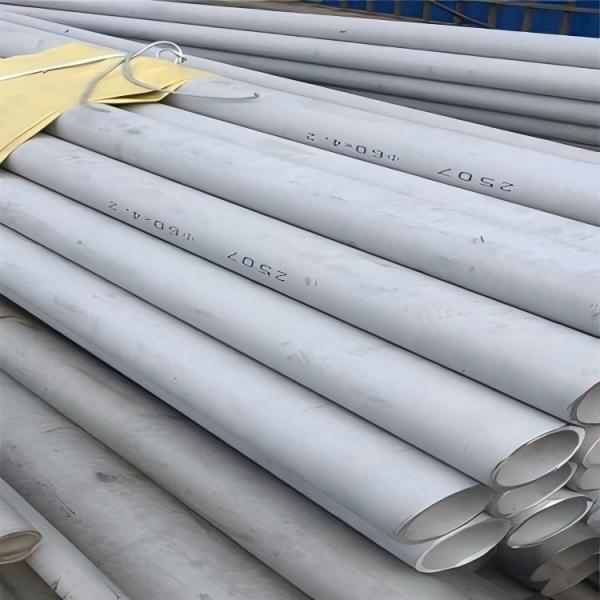
2507 duplex stainless steel pipes for chloride and seawater applications
2205 or 2507? Start With the Actual Operating Conditions
There is no universal temperature or chloride concentration at which an engineer should automatically switch from 2205 to 2507. Material selection should be based on the complete corrosion environment rather than a single parameter.
At Ganyeah Group, we recommend evaluating at least these factors:
Chloride concentration
Higher chloride levels generally increase the risk of pitting and crevice corrosion. Seawater and concentrated chloride solutions can therefore require higher-alloy materials.
Operating temperature
As temperature increases, localized corrosion can become more difficult to control. A material that performs well at moderate temperature may not provide the same corrosion margin at elevated temperature.
Fluid chemistry
Chlorides are only one consideration. pH, dissolved oxygen, H₂S, CO₂, oxidizing species and other contaminants can significantly affect material performance.
Pressure and wall thickness
Because duplex grades have high yield strength, they can offer advantages in pressure-containing applications. However, the final wall thickness must always be calculated according to the applicable design code.
Welding and fabrication
Duplex and super duplex materials require appropriate control of heat input, interpass temperature and phase balance. Fabrication requirements should therefore be considered before final material selection.
A Practical 2205 vs 2507 Selection Guide
A simple project-based approach is:
Choose 2205 when:
- The environment contains chloride but is not exceptionally aggressive.
- Operating temperatures remain within the grade’s qualified service range.
- The project needs better corrosion resistance than 316L without moving to a super duplex grade.
- Cost optimization is an important consideration.
Consider 2507 when:
- The piping is continuously exposed to seawater.
- Chloride concentration is particularly high.
- Operating temperature increases localized corrosion risk.
- Pitting and crevice corrosion must be minimized.
- The project specification explicitly requires super duplex stainless steel.
In other words, 2205 is often the balanced engineering solution, while 2507 is the choice when the corrosion environment demands a larger performance margin.
Why Higher Strength Matters in Pipeline Design
Corrosion resistance is not the only advantage of duplex stainless steel.
The high yield strength of duplex grades can allow engineers to achieve required pressure ratings with thinner sections in suitable designs. This may reduce material weight and, depending on the project, simplify transportation and installation.
For offshore and marine projects, where every kilogram of installed equipment can affect handling and construction costs, the combination of high strength and corrosion resistance is particularly valuable.
Nevertheless, thinner wall design should never be assumed simply from the material grade. The final design must comply with the relevant piping code, pressure rating, corrosion allowance, fabrication requirements and project specifications.
Ganyeah Group: Duplex Stainless Steel for Demanding Pipeline Projects
Ganyeah Group supplies stainless steel and duplex stainless steel products for industrial pipeline applications, including grades such as 2205, S31803, S32205, 2507 and S32750.
Our experience covers products used in demanding environments where material grade, dimensional accuracy, surface condition and applicable standards all need to work together.
For a duplex stainless steel pipe project, we can assist with requirements such as:
- Material and grade selection
- ASTM A789 / ASTM A790 requirements
- Seamless and welded pipe options
- Dimensional and wall-thickness requirements
- MTC and material traceability
- Inspection and testing requirements
- Project-specific packaging and delivery
- Supporting stainless steel fittings and pipeline components
For example, when a project involves seawater or a high-chloride process stream, our technical team can compare S32205 vs S32750 based on the actual operating conditions rather than recommending the more expensive grade by default.
The objective is simple: select a material that meets the service requirements while keeping the total project cost under control.
If you are currently sourcing 2205 duplex stainless steel pipe or 2507 super duplex stainless steel pipe, send Ganyeah Group your size, wall thickness, operating medium, temperature, pressure and applicable standard. Our team can help evaluate the appropriate grade and supply configuration.
Frequently Asked Questions
1. Is 2507 better than 2205?
Not necessarily. 2507 has higher alloy content and stronger resistance to aggressive chloride corrosion, but 2205 may be the more economical choice when its corrosion and mechanical performance already meet the design requirements.
2. Is 2205 more corrosion resistant than 316L?
In many chloride-containing environments, 2205 provides significantly better resistance to pitting, crevice corrosion and chloride stress corrosion cracking than conventional 316L. Actual performance depends on the service environment.
3. When should I use 2507 instead of 2205?
2507 should be considered for highly aggressive environments such as continuous seawater exposure, high-chloride service and demanding offshore applications, particularly when project specifications require a super duplex grade.
4. Can 2205 and 2507 be welded?
Yes. Both grades can be welded using qualified procedures. However, welding requires careful control of heat input, interpass temperature and phase balance to maintain the required properties of the duplex microstructure.
5. What standards are commonly used for duplex stainless steel pipe?
ASTM A789 is commonly associated with seamless and welded ferritic/austenitic stainless steel tubing, while ASTM A790 covers seamless and welded ferritic/austenitic stainless steel pipe. The exact specification should be confirmed according to the project and product type.