


How to Prevent Stainless Steel Pipe Cracking During Fabrication: Proven Manufacturing Practices
Stainless steel pipes are widely used in industries that demand high strength, corrosion resistance, and long service life. However, cracks that develop during fabrication can significantly reduce product reliability, increase maintenance costs, and even cause system failures. Understanding how to prevent stainless steel pipe cracking is essential for manufacturers, fabricators, and end users alike.
At Ganyeah Group, quality control begins with raw material selection and continues through every stage of production, including welding, forming, inspection, and finishing. By following strict manufacturing standards, Ganyeah delivers high-quality stainless steel pipes that perform reliably in demanding industrial applications.
Why Does Stainless Steel Pipe Cracking Occur?
Cracks in stainless steel pipes rarely result from a single factor. They are usually caused by a combination of poor raw materials, improper welding procedures, excessive grinding, or inadequate weld penetration.
The good news is that most cracking problems can be prevented through proper material selection and controlled manufacturing processes.
Understanding how to prevent stainless steel pipe cracking starts with identifying these critical factors before production begins.
1. Select High-Quality Refined Steel Strip
The quality of the steel strip directly determines the quality of the finished stainless steel welded pipe.
Steel strips produced by refined steelmaking processes contain fewer impurities and offer more stable chemical composition than materials produced from recycled scrap using intermediate-frequency furnaces.
Key advantages include:
- Better ductility and elongation
- Lower carbon content
- Reduced inclusions and impurities
- Improved forming performance
- Lower risk of cracking during fabrication
Some low-cost raw materials contain excessive carbon and impurities, making the pipe harder and more brittle after forming. Over time, these defects may develop into visible cracks during bending, welding, or service.
At Ganyeah Group, only qualified raw materials from reliable suppliers are used to ensure consistent mechanical properties and long-term durability.
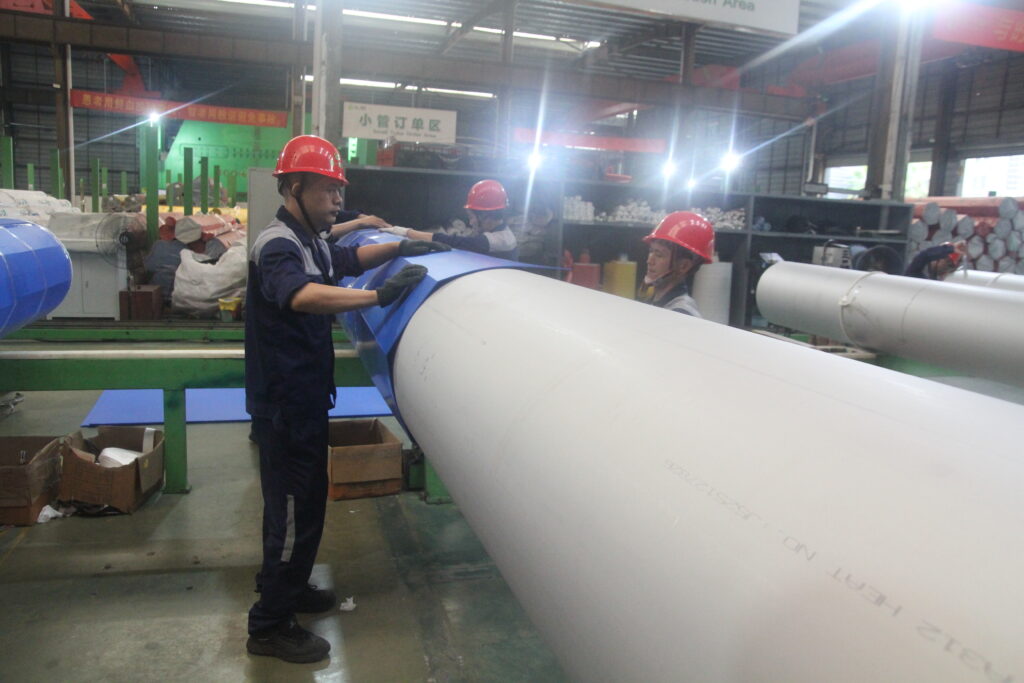
Schedule 40 stainless steel pipes manufactured by Ganyeah Group
2. Avoid Excessive Weld Grinding
Another common cause of cracking is over-grinding after welding.
During polishing, removing excessive material can significantly reduce weld thickness. A weakened weld area becomes more susceptible to stress concentration during fabrication or operation.
Proper weld finishing should:
- Remove surface irregularities without weakening the weld
- Maintain adequate weld reinforcement
- Preserve structural integrity
- Meet project specifications
Strict inspection procedures help ensure that every stainless steel pipe maintains sufficient weld strength after finishing.
3. Use Nitrogen Back Purging During Welding
One of the most effective ways of preventing stainless steel pipe cracking is protecting the weld root with nitrogen during internal welding.
Without inert gas protection, oxidation occurs easily inside the pipe, resulting in:
- Oxidized weld roots
- Reduced corrosion resistance
- Surface defects
- Higher probability of crack formation
Nitrogen back purging creates a clean welding environment and offers several benefits:
- Protects both internal and external weld surfaces
- Produces smoother weld beads
- Reduces oxidation
- Improves corrosion resistance
- Minimizes crack formation
- Extends service life
This process is especially important for stainless steel welded pipe used in food processing, pharmaceuticals, water treatment, and chemical industries.
4. Ensure Complete Weld Penetration
Incomplete penetration is another major reason why cracks appear after fabrication.
If welding speed is too high or heat input is insufficient, the weld may fail to penetrate the full wall thickness.
Poor penetration creates hidden defects that become weak points under pressure, vibration, or thermal cycling.
To ensure complete penetration, manufacturers should carefully control:
- Welding current
- Travel speed
- Heat input
- Joint preparation
- Welding parameters
- Operator consistency
Complete weld fusion significantly improves both mechanical strength and long-term reliability.
Quality Control Makes the Difference
Preventing cracks is not simply about improving one production step. It requires comprehensive quality management throughout the manufacturing process.
At Ganyeah Group, every production stage follows strict quality procedures, including:
- Incoming raw material verification
- Chemical composition inspection
- Welding parameter control
- Nitrogen protection during welding
- Dimensional inspection
- Weld appearance examination
- Non-destructive testing (NDT)
- Mechanical property testing
- Surface finishing inspection
These measures ensure that every stainless steel welded pipe meets international quality standards before shipment.
A Practical Example from Ganyeah Group
A recent project for a chemical processing customer required large quantities of 304L stainless steel welded pipe with exceptionally high weld quality for corrosive media transportation.
To minimize fabrication risks, Ganyeah Group implemented several enhanced production measures:
- Refined steel strip with stable composition
- Automatic TIG welding
- Continuous nitrogen back purging
- Controlled weld reinforcement
- 100% visual inspection
- Hydrostatic pressure testing
- Pickling and passivation after welding
The completed pipes passed all inspection requirements and were successfully installed without any weld-related cracking during fabrication or commissioning, demonstrating the effectiveness of Ganyeah Group’s manufacturing controls.
Choosing a Reliable Stainless Steel Pipe Supplier
When selecting a supplier, buyers should look beyond price alone.
A qualified manufacturer should provide:
- Certified raw materials
- Advanced welding technology
- Complete quality inspection records
- Experienced production engineers
- International certifications
- Consistent product traceability
These factors greatly reduce the risk of cracking and improve the overall reliability of pipeline systems.
Knowing how to prevent stainless steel pipe cracking is essential for achieving reliable performance throughout the service life of industrial piping systems. High-quality raw materials, controlled welding procedures, nitrogen protection, proper weld penetration, and rigorous quality inspection all play critical roles in minimizing crack formation.
As a professional manufacturer of stainless steel pipes and stainless steel welded pipes, Ganyeah Group combines advanced production technology with strict quality management to deliver products that meet the demanding requirements of industries such as petrochemical processing, food production, water treatment, energy, construction, and marine engineering.
Whether your project requires standard stainless steel tubing or customized industrial pipeline solutions, Ganyeah Group is committed to providing dependable products backed by consistent manufacturing quality.
Frequently Asked Questions (FAQ)
1. What is the most common cause of stainless steel pipe cracking?
Poor-quality raw materials, incomplete weld penetration, excessive weld grinding, and inadequate shielding gas protection are the most common causes of cracking.
2. Why is nitrogen used during stainless steel pipe welding?
Nitrogen protects the weld root from oxidation, improves corrosion resistance, produces cleaner welds, and significantly reduces the risk of cracking.
3. Can low-quality steel strip increase cracking risk?
Yes. Steel strips with high carbon content or excessive impurities have lower ductility and are more likely to crack during forming or long-term service.
4. Does complete weld penetration improve pipe durability?
Absolutely. Full weld penetration eliminates weak fusion zones, increases mechanical strength, and improves pressure resistance.
5. How does Ganyeah Group ensure crack-free stainless steel pipes?
Ganyeah Group uses refined steel strip, automatic precision welding, nitrogen back purging, strict process control, comprehensive inspections, and multiple quality tests to ensure consistent product performance.