


How to Prevent Cracking in Stainless Steel Tubes During Deep Processing
Stainless steel tubes are widely used in applications where appearance, corrosion resistance, dimensional accuracy and fabrication performance all matter. However, when a tube is subjected to bending, flaring, stretching or other deep-processing operations, cracking can become a serious quality concern.
In many cases, the problem is not caused by the final forming operation itself. The real cause can be traced back to the quality of the strip, welding condition, weld finishing or insufficient penetration during tube production.
For manufacturers and buyers of stainless steel tubes for bending and deep processing, selecting the right material and controlling the production process from the beginning are therefore essential. At Ganyeah Group, we pay particular attention to these factors when supplying stainless steel welded tubes for applications that require reliable forming performance.
Why Do Stainless Steel Tubes Crack During Processing?
Cracking generally occurs when the material cannot withstand the tensile stress generated during forming. A tube may look acceptable after welding and surface finishing, but hidden weaknesses in the base material or weld zone can become obvious when the tube is bent or expanded.
Several factors can contribute to cracking:
Poor-quality raw material with excessive impurities
High hardness and insufficient ductility
Excessive grinding at the weld seam
Weld oxidation caused by inadequate internal shielding
Incomplete weld penetration or fusion
Improper welding speed and heat input
Unsuitable forming conditions for the selected stainless steel grade
For this reason, preventing stainless steel tube cracking should begin before the tube reaches the customer’s fabrication line.
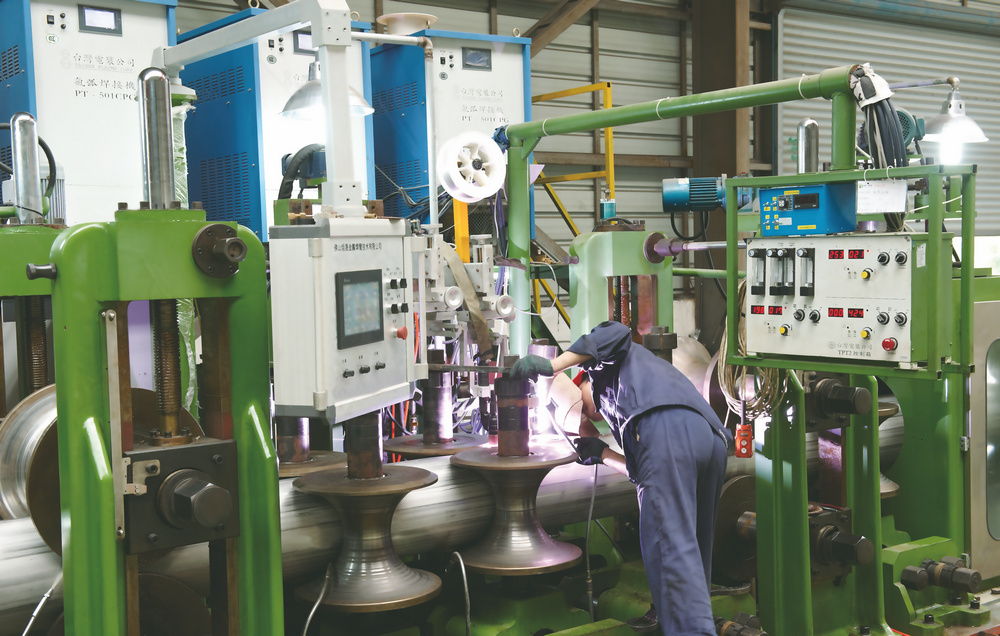
Stainless steel tubes undergoing precision bending and deep processing
1. Start with High-Quality Refined Stainless Steel Strip
The quality of the raw strip has a direct influence on the forming performance of the finished tube.
For stainless steel tubes that will undergo bending, flaring, drawing or stamping, the material should have consistent chemical composition, clean metallurgy and adequate ductility. Lower-quality recycled or poorly controlled feedstock can contain excessive impurities and may have higher hardness or inconsistent mechanical properties.
These problems may not always be visible during routine inspection. However, they can become significant during deep processing.
At Ganyeah Group, material selection is treated as an important part of tube quality control. For demanding stainless steel tube applications, the raw material should be selected according to the required grade, mechanical properties, surface condition and intended fabrication process.
Why does material quality matter for tube bending?
A tube intended for deep processing needs sufficient elongation and uniformity. If the material is excessively hard or brittle, localized stress can develop during bending, increasing the possibility of cracks.
This is particularly important for applications involving:
- Tight-radius tube bending
- Tube flaring
- End forming
- Expansion
- Stamping
- Drawing
- Repeated forming operations
Therefore, when purchasing stainless steel tubes for deep processing, buyers should evaluate not only chemical composition but also mechanical properties and actual forming requirements.
2. Avoid Excessive Grinding of the Weld Seam
For welded stainless steel tubes, the weld zone requires special attention.
Grinding can improve the appearance of a tube and help achieve a smoother external surface. However, excessive grinding removes too much material from the weld area. If the weld becomes significantly thinner than the surrounding tube wall, its load-bearing capacity can be reduced.
The weakened area may then become the starting point for cracking during bending or stretching.
A properly controlled finishing process should therefore achieve the required surface appearance without unnecessarily reducing weld thickness.
At Ganyeah Group, welding and finishing are considered as connected processes rather than independent operations. The objective is not simply to make the weld visually smooth, but to maintain a sound and structurally reliable weld zone suitable for the specified application.
Weld appearance is not the same as weld quality
A highly polished weld does not automatically mean a stronger weld.
For stainless steel welded tubes for bending applications, the important factors include:
- Weld penetration
- Fusion quality
- Weld geometry
- Heat-affected zone condition
- Surface condition
- Dimensional consistency
- Mechanical integrity after forming
This is why visual appearance should always be supported by appropriate inspection and process control.

Seamless and welded stainless steel pipe specifications by Ganyeah Group
3. Use Internal Gas Shielding During Welding
Stainless steel is highly sensitive to oxidation during welding. If the inside of the tube is exposed to air while the weld is hot, oxidation can occur on the internal weld surface.
This can result in an undesirable oxidized area and may negatively affect corrosion resistance and weld integrity.
For stainless steel tube production, internal gas protection can help reduce oxidation and protect the root side of the weld. Depending on the welding procedure and product requirements, controlled shielding gas is used to create a cleaner welding environment.
For demanding applications, this is especially important because the inside surface of the tube may directly contact the transported medium.
A clean internal weld can help improve:
- Corrosion resistance
- Weld consistency
- Internal surface quality
- Long-term service reliability
- Resistance to defects during subsequent forming
The exact shielding gas and welding parameters should be determined according to the stainless steel grade, tube dimensions, welding method and applicable specification rather than applying one fixed process to every product.
4. Ensure Complete Weld Penetration
Incomplete penetration is another potential cause of cracking.
When welding speed is too high or heat input is insufficient, the joint may not be completely fused through the required section. The outside of the tube can still appear acceptable, while an internal lack of fusion or incomplete penetration remains hidden.
During subsequent bending or flaring, stress concentrates around the weak area. The defect can then develop into a visible crack.
For this reason, stainless steel tube welding quality must be controlled through appropriate combinations of:
- Welding current
- Welding voltage
- Welding speed
- Heat input
- Electrode or filler selection
- Shielding conditions
- Tube wall thickness
- Joint preparation
The goal is not simply to increase heat. Excessive heat can also create undesirable metallurgical changes, distortion or excessive oxidation. A stable and qualified welding procedure is the better approach.
5. Match the Tube Grade to the Processing Requirement
Different stainless steel grades have different levels of strength, ductility and work-hardening behavior.
For example, common austenitic grades such as 304 and 316L generally offer good forming characteristics, while higher-strength or specialized stainless steels may require more careful control during bending and cold forming.
Before placing an order, buyers should provide the manufacturer with the actual fabrication requirements instead of specifying only the tube size and material grade.
Useful information includes:
| Requirement | Why It Matters |
| Tube OD and wall thickness | Determines forming stress and deformation |
| Stainless steel grade | Influences strength, ductility and work hardening |
| Bending radius | Affects tensile strain on the outer wall |
| Flaring requirement | Determines local expansion stress |
| Drawing or stretching | Requires sufficient elongation |
| Surface requirement | Determines finishing process |
| Welded or seamless | Influences manufacturing route |
| Final application | Determines inspection and quality requirements |
This information allows the tube manufacturer to select a production route that is better suited to the final fabrication process.
6. Quality Control Should Continue Beyond the Finished Tube
Preventing cracking is not achieved through one inspection step. It requires process control throughout production.
For stainless steel tubes supplied by Ganyeah Group, quality management can cover the complete production chain, from material verification to final inspection.
Depending on project requirements, quality control may include:
Raw material verification
Chemical composition, material grade and relevant mechanical properties are checked against the purchasing specification.
Dimensional inspection
Outside diameter, wall thickness, length and other dimensional characteristics are controlled to ensure consistency.
Weld inspection
The weld is evaluated according to the applicable specification and customer requirements.
Surface inspection
The tube surface and weld area are checked for visible defects, excessive grinding and other abnormalities.
Non-destructive testing
Where required, suitable NDT methods can be applied to verify weld or tube integrity.
Hydrostatic or other specified testing
Testing is performed according to the applicable product standard or project specification.
The exact inspection scope depends on the tube grade, dimensions, standard and intended service.
Ganyeah Group: Stainless Steel Tubes Designed Around the Final Application
For industrial buyers, the most important question is not simply whether a stainless steel tube meets a material specification. It is whether the tube can perform reliably after it reaches the fabrication workshop.
This is particularly important when tubes will be bent, flared, expanded or otherwise formed.
Ganyeah Group combines stainless steel material selection, tube manufacturing, welding control, surface finishing and inspection to provide products suited to demanding industrial applications. When a customer requires tubes for deep processing, the manufacturing discussion can begin with the final forming requirement rather than stopping at dimensions and grade.
This approach helps reduce the risk of purchasing a tube that meets the basic specification but performs poorly during fabrication.
For projects requiring crack-resistant stainless steel tubes for bending, flaring and deep processing, Ganyeah Group can evaluate the material grade, tube dimensions, forming conditions and quality requirements before production.
How to Reduce the Risk of Stainless Steel Tube Cracking
A practical approach can be summarized in five steps:
Select clean and consistent raw material.
Choose a stainless steel grade suitable for the intended forming operation.
Control welding parameters and provide appropriate internal shielding.
Avoid excessive weld grinding and ensure complete penetration.
Verify tube quality before shipment and, where necessary, validate forming performance.
The key point is simple: cracking should be prevented at the manufacturing stage rather than discovered during the customer’s fabrication process.
FAQ
Why do stainless steel tubes crack when bent?
Cracking can result from insufficient ductility, excessive work hardening, poor raw material quality, an unsuitable bending radius, weld defects or excessive thinning of the weld area. The actual cause should be determined according to the material and forming conditions.
Can welded stainless steel tubes be used for bending?
Yes. Properly manufactured welded stainless steel tubes can be suitable for bending and other forming operations. The material grade, weld quality, wall thickness, bending radius and production process all need to be considered.
Does weld grinding affect stainless steel tube strength?
It can. Excessive grinding may reduce the effective thickness of the weld zone and create a weaker section. Weld finishing should therefore be controlled to achieve the required surface condition without unnecessarily removing material.
Why is internal gas shielding important when welding stainless steel tubes?
Internal shielding reduces oxidation on the root side of the weld. This helps maintain a cleaner internal surface and supports better corrosion resistance and weld quality.
What should I tell Ganyeah Group when ordering tubes for deep processing?
In addition to material grade, outside diameter and wall thickness, provide the intended bending radius, flaring or expansion requirements, forming method, surface requirements and applicable standard. This allows the production process to be matched to the final application.
Talk to Ganyeah Group About Your Stainless Steel Tube Requirements
If your project involves stainless steel tube bending, flaring, drawing or other deep-processing operations, selecting the right tube at the beginning can significantly reduce cracking risks and fabrication losses.
Share your required grade, size, wall thickness, standard and forming requirements with Ganyeah Group. Our team can help evaluate a suitable stainless steel tube solution for your application.