


ASTM A778 Stainless Steel Pipe: A Complete Guide to Welded Unannealed Austenitic Stainless Steel Tubular Products
Introduction
ASTM A778 is one of the most widely recognized standards for welded stainless steel tubular products used in low- to moderate-corrosion environments where full solution annealing is not required.
Officially titled:
ASTM A778 – Standard Specification for Welded, Unannealed Austenitic Stainless Steel Tubular Products
This specification covers welded austenitic stainless steel tubing manufactured from flat-rolled stainless steel sheet, strip, or plate without subsequent annealing after welding.
Compared with ASTM A312 welded pipe, ASTM A778 products offer significant cost advantages while still providing excellent corrosion resistance and mechanical performance for many industrial applications.
This article explains everything you need to know about ASTM A778 stainless steel tubing, including manufacturing methods, material grades, dimensions, applications, advantages, limitations, and key differences from ASTM A312.
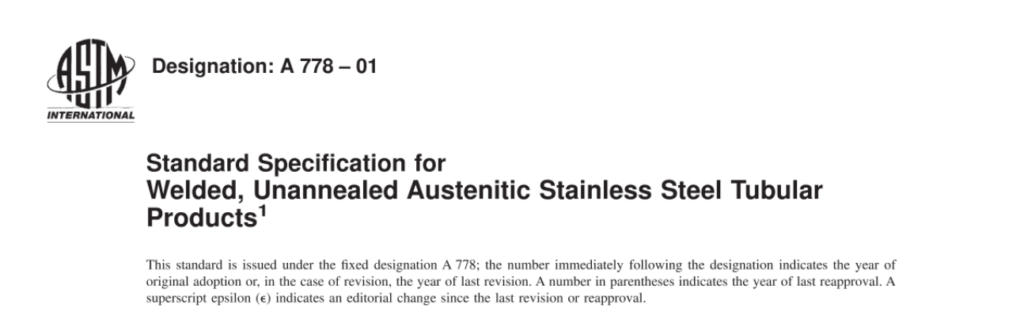
ASTM A778
What Is ASTM A778?
ASTM A778 covers:
Welded, unannealed austenitic stainless steel tubular products intended for general corrosive service and low- to moderate-temperature applications.
Unlike ASTM A312 welded pipe, which normally requires solution annealing after welding, ASTM A778 permits tubing to be supplied in the as-welded condition.
Because the weld area is not subjected to full post-weld heat treatment, manufacturing costs are lower and production efficiency is higher.
For many applications, this provides an excellent balance between performance and economy.
Scope of ASTM A778
The specification applies to:
- Straight-seam welded stainless steel tubing
- Austenitic stainless steel grades
- Round tubular products
- Corrosion-resistant applications
- Low and moderate pressure service
ASTM A778 is commonly used where:
- Extreme corrosion resistance is not required
- High-pressure service is not involved
- Cost optimization is important
Typical industries include:
- Water treatment
- Food processing
- Chemical transfer systems
- Architectural structures
- Industrial fabrication
- Pulp and paper plants
- Wastewater treatment facilities
Manufacturing Process of ASTM A778 Tubing
ASTM A778 tubing is manufactured from stainless steel strip or plate using automatic welding processes.
The typical production route is:
Raw Material Inspection
↓
Slitting
↓
Forming
↓
TIG Welding / Laser Welding
↓
Weld Bead Conditioning
↓
Sizing
↓
Straightening
↓
Nondestructive Testing
↓
Cutting and Packaging
Unlike ASTM A312 welded pipe, there is generally no full solution annealing step after welding.
This is the primary feature that distinguishes ASTM A778 from many other stainless steel pipe specifications.
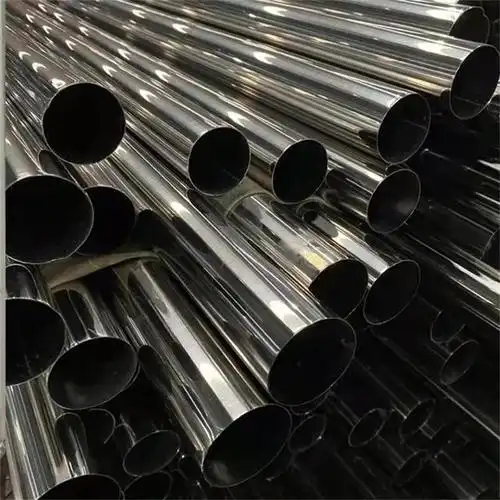
ASTM A778 Stainless Steel Pipes
Approved Material Grades
ASTM A778 covers many common austenitic stainless steel grades.
The most frequently used grades include:
| UNS Number | Grade |
|---|---|
| S30400 | 304 |
| S30403 | 304L |
| S31600 | 316 |
| S31603 | 316L |
| S32100 | 321 |
| S34700 | 347 |
| S31703 | 317L |
| S31008 | 310S |
Among these, 304L and 316L are the most popular due to their excellent combination of corrosion resistance, weldability, and cost-effectiveness.
Welding Methods Used
ASTM A778 permits several welding technologies, including:
GTAW (TIG Welding)
Gas Tungsten Arc Welding is the most commonly used method for high-quality stainless steel tubing.
Benefits include:
- Smooth weld appearance
- Excellent penetration
- Low contamination risk
- High dimensional accuracy
Laser Welding
Laser-welded ASTM A778 tubing offers:
- Narrow heat-affected zones
- Faster production speed
- Excellent surface finish
- High precision
Automatic Orbital Welding
Used for specialized production requiring consistent weld quality.
Inspection and Testing Requirements
Although ASTM A778 does not require post-weld annealing, it still imposes strict quality requirements.
Typical inspections include:
Hydrostatic Testing
Used to verify pressure integrity.
Air Underwater Testing
Detects leakage through pressurized air testing.
Eddy Current Testing
Detects surface and subsurface defects.
Dimensional Inspection
Verifies:
- Outside diameter
- Wall thickness
- Ovality
- Straightness
- Length tolerance
Visual Examination
Ensures weld quality and surface finish.
Surface Finish Options
ASTM A778 tubing can be supplied in various finishes:
Mill Finish
Economical industrial finish.
Pickled and Passivated (AP)
Improved corrosion resistance through removal of heat tint and surface contaminants.
Mechanical Polished (MP)
Suitable for sanitary and decorative applications.
Bright Annealed (BA)
Available when special processing is requested, although standard ASTM A778 itself does not require bright annealing.
Advantages of ASTM A778 Stainless Steel Tubing
Lower Manufacturing Cost
The elimination of post-weld solution annealing significantly reduces production costs.
Compared with ASTM A312 welded pipe:
- Lower energy consumption
- Shorter production cycle
- Reduced manufacturing complexity
Good Corrosion Resistance
The tubing retains the inherent corrosion resistance of austenitic stainless steels.
Excellent Availability
ASTM A778 tubing can be manufactured quickly and efficiently.
Smooth Internal Surface
Modern welding technology allows excellent weld quality and flow characteristics.
Cost-Effective for Large Projects
Many industrial projects can achieve substantial cost savings by selecting ASTM A778 instead of fully annealed pipe.
Limitations of ASTM A778
While ASTM A778 offers many advantages, it also has limitations.
Not Ideal for Severe Corrosion Service
The weld zone may not have the same corrosion resistance as fully solution-annealed products.
Not Recommended for Extreme Pressure Applications
High-pressure systems often specify ASTM A312 instead.
Reduced Resistance to Intergranular Corrosion
In aggressive chemical environments, post-weld annealed tubing may perform better.
Not Suitable for Ultra-High Purity Systems
Semiconductor, pharmaceutical, and ultra-high purity gas applications typically require:
- ASTM A269
- ASTM A270
- BA tubing
- EP tubing
rather than ASTM A778.
ASTM A778 vs ASTM A312
This is one of the most common questions among engineers and buyers.
| Property | ASTM A778 | ASTM A312 |
|---|---|---|
| Manufacturing | Welded | Seamless or Welded |
| Post-Weld Annealing | Not Required | Usually Required |
| Cost | Lower | Higher |
| Corrosion Resistance | Good | Better |
| High Pressure Service | Limited | Excellent |
| Chemical Processing | Moderate | Severe Service |
| Delivery Time | Faster | Longer |
| Typical Applications | Utility Service | Process Service |
When to Choose ASTM A778
Choose ASTM A778 when:
- Budget is a major consideration
- Corrosion conditions are moderate
- Large quantities are required
- Pressure requirements are not extreme
When to Choose ASTM A312
Choose ASTM A312 when:
- High pressure exists
- Severe corrosion is expected
- Critical process piping is involved
- Project specifications require solution annealing
Typical Applications of ASTM A778 Tubing
ASTM A778 products are widely used in:
Water Treatment Systems
- Potable water
- Industrial water
- Cooling water systems
Food and Beverage Industry
- Processing equipment
- Utility piping
- CIP systems
Chemical Plants
- Mild chemical transfer
- Storage tank piping
Architectural Projects
- Handrails
- Structural tubing
- Decorative systems
Industrial Utilities
- Compressed air systems
- Process water systems
- General service piping
Why ASTM A778 Remains Popular
Despite the availability of more advanced stainless steel pipe standards, ASTM A778 continues to be widely specified because it delivers an excellent balance between cost and performance.
For many industrial systems, fully solution-annealed pipe is unnecessary. ASTM A778 provides sufficient corrosion resistance, reliable weld quality, and long service life while significantly reducing project costs.
As a result, ASTM A778 remains one of the most economical stainless steel tubing standards for general industrial service worldwide.
Conclusion
ASTM A778 is the leading specification for welded, unannealed austenitic stainless steel tubular products. By eliminating the post-weld annealing process, it offers lower production costs and faster manufacturing while maintaining good corrosion resistance and structural integrity.
For water treatment, food processing, utility piping, architectural applications, and general industrial service, ASTM A778 stainless steel tubing is often the most cost-effective solution.
When selecting between ASTM A778 and ASTM A312, engineers should evaluate pressure requirements, corrosion conditions, project specifications, and budget considerations to determine the most suitable option.
Ganyeah Group supplies high-quality ASTM A778 welded stainless steel tubing in 304, 304L, 316, and 316L grades, providing reliable solutions for industrial piping projects worldwide.